I promised a cake, and then I panicked. A friend was coming for dinner, I had said something breezy like "I'll bring dessert," and by four in the afternoon I realised I had no butter softened, no chocolate in the cupboard, and a fridge that was mostly condiments and good intentions. What I did have was a bottle of olive oil, two lemons, an orange that had been sitting in the fruit bowl for a week, and a bag of flour. That was the day I baked my first olive oil cake, mostly because I had run out of excuses not to.
I had always thought of olive oil cake as something fancy people made. The kind of cake you read about in a cookbook with glossy photographs, served on a white plate with a sprig of something green on top. It sounded like a cake that required confidence, and confidence was not what I had that afternoon. What I had was a deadline — dinner at seven — and a stubborn refusal to turn up empty-handed.
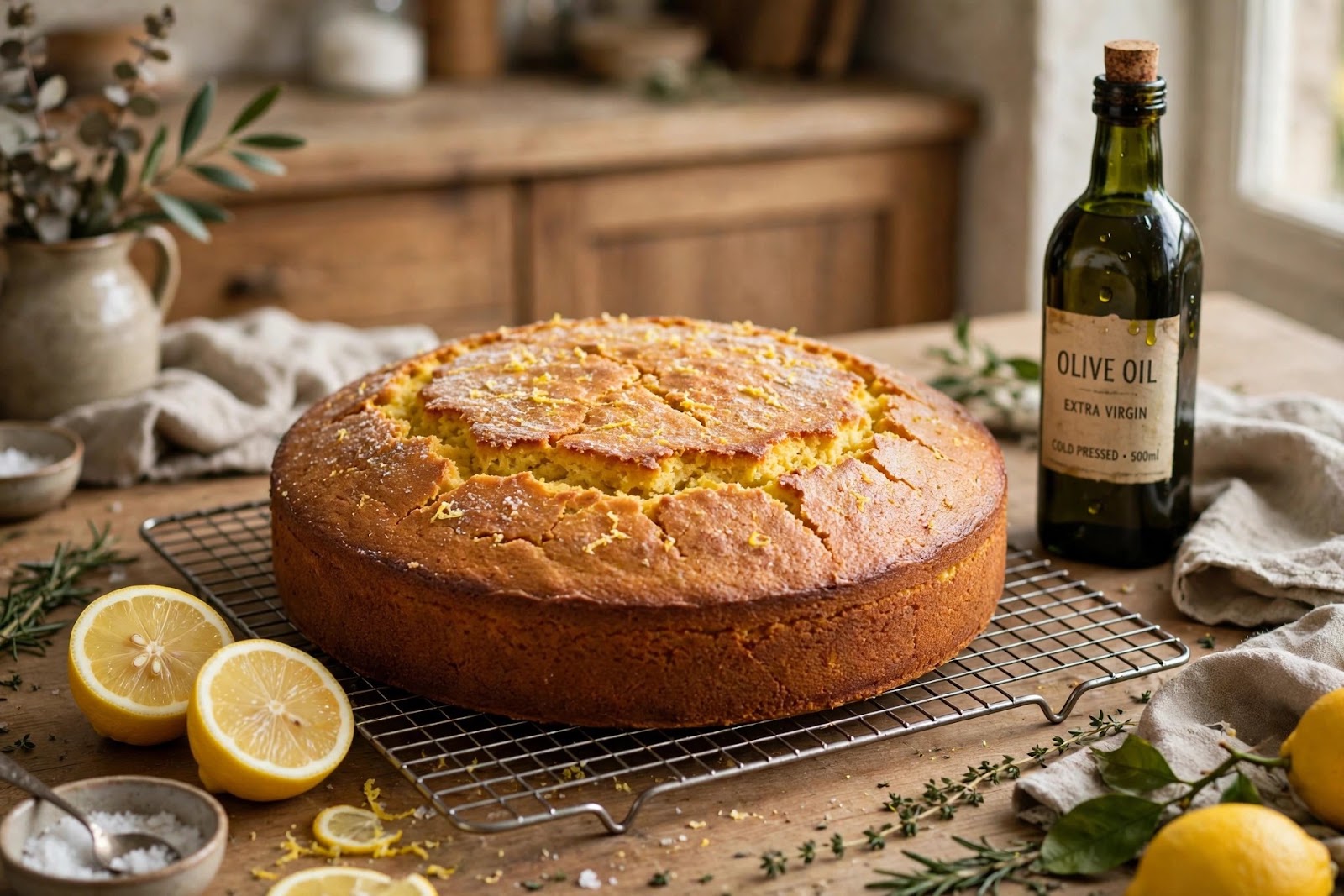
So I read three recipes, argued with all of them, and then did what I usually do when recipes disagree: I picked the middle path and hoped for the best. The cake that came out of the oven that evening was not perfect. It had a crack across the top, one side rose a little higher than the other, and I forgot the powdered sugar until I was already at my friend's door. But when we cut into it, the crumb stopped me mid-sentence. It was tender in a way my butter cakes rarely were, moist without being wet, and it tasted of lemon in the front and something warm and peppery at the back that I could not quite name. I have baked it at least a dozen times since, and I still make it the same way, with only small changes. This is the version that works in my kitchen.
The oil question, and the bottle I actually used
Here is the part everyone overthinks, including me the first time. Olive oil is not one flavour. A grassy, peppery, expensive extra-virgin oil that is wonderful on a salad can take over a cake completely, and a bland "light" olive oil adds moisture but almost no character at all. Neither extreme is what you want for a first attempt.
I used the mid-range extra-virgin oil from my local grocery store, the one I cook with every day. It cost about eight pounds for a 500-millilitre bottle, which felt reasonable, and it tasted fruity rather than fiercely peppery when I tried a drop on my finger. That test matters more than the label. Taste your oil before you bake with it. If it burns your throat with pepper, it will do the same thing to your cake, only louder. If it tastes flat and greasy, your cake will taste flat and greasy too.
For this recipe you need 180 millilitres, which is roughly three-quarters of a cup. That sounds like a lot when you pour it into the measuring jug, and I remember staring at it and thinking I must have misread the recipe. I had not. Oil cakes need that much fat to stay moist, and because oil stays liquid at room temperature, the cake stays soft for days in a way a butter cake does not. A butter cake firms up in the fridge and needs warming to taste right again. An olive oil cake, wrapped well, is still tender on day three straight from the counter. That alone has made it my default cake for bringing to other people's houses.
One thing I will say plainly: do not use the fancy bottle you save for drizzling over finished dishes. Save that for the salad. Baking needs a good, honest, everyday extra-virgin oil, not the one you would mourn if you poured three-quarters of a cup of it into a bowl. I learned that the expensive way once, with a bottle that cost twice what this cake was worth, and the cake did not taste twice as good. It tasted the same, and I was annoyed with myself for a week.
Why citrus, and why I use two kinds
An olive oil cake without citrus is a perfectly nice cake, but it is a quiet one. Citrus gives it a voice. Lemon brings sharpness, orange brings roundness, and together they stop the oil from tasting heavy. My version uses the zest of two lemons and one orange, plus the juice of one lemon, about 45 millilitres. I zest first and juice second, because trying to zest a squeezed lemon half is a miserable job and I have the knuckles to prove it.
Zest matters more than juice here, and that surprised me. Juice adds liquid and a bit of tang, but zest carries the actual perfume of the fruit — the oils in the skin that make the whole kitchen smell like a lemon grove when you rub it into the sugar. That rubbing step is not decoration. When you work the zest into the sugar with your fingertips for a minute, the sugar turns pale yellow and slightly damp, and the flavour goes all the way through the cake instead of sitting on top of it. Skip it and you get a cake that smells lovely for five minutes and then tastes plain. Do it and the flavour lasts to the last slice.
The orange in this recipe is doing quiet work. On its own, lemon can make an oil cake taste a little sharp, almost like a cleaning product if you overdo it, which I did on attempt number three when I doubled the lemon juice "for extra flavour" and produced something my friend politely called "very refreshing." Orange softens that edge. It adds a warm sweetness that is not sugar sweetness, and it makes the lemon taste like lemon instead of like acid. If you only have lemons, the cake still works — use the zest of three lemons and skip the orange — but if you have one orange, use it.

The full recipe, exactly as I make it now
You need a 20-centimetre (8-inch) round cake tin, lined on the base with baking paper and lightly brushed with oil on the sides. Preheat the oven to 175 degrees Celsius, or 160 fan. I bake on the middle shelf, and I do not open the door for the first 35 minutes, no matter how curious I am. Every time I have peeked early, the middle has dipped out of spite.
For the dry ingredients: 250 grams of plain flour, 2 teaspoons of baking powder, half a teaspoon of fine sea salt. Whisk them together in a bowl and set it aside. For the wet side: 3 large eggs at room temperature, 200 grams of caster sugar, the zest of two lemons and one orange, 180 millilitres of extra-virgin olive oil, 45 millilitres of lemon juice, 120 millilitres of whole milk, and a teaspoon of vanilla extract. That is the whole list. No buttermilk, no sour cream, no ingredients you have to hunt for.
Start by rubbing the zest into the sugar with your fingertips until it smells like a lemon grove and looks faintly yellow. Then whisk in the eggs, one at a time, until the mixture is pale and slightly thick, about two minutes by hand or one minute with an electric whisk. Pour in the oil in a slow, steady stream while you whisk, the way you would for a mayonnaise, though do not panic about the technique. The batter will look glossy and a little loose, and that is right. Add the lemon juice, milk, and vanilla, then fold in the dry ingredients in two goes, mixing only until the flour disappears. Overmixing is the one mistake that will toughen this cake, and it is easy to do when the batter looks so smooth that you keep stirring out of habit. Stop when you cannot see flour anymore. A few tiny lumps are fine.
Pour the batter into the tin and give the tin two firm taps on the counter to pop any large air bubbles. Bake for 45 to 55 minutes. My oven takes 50 minutes exactly, and I test at 45 with a skewer pushed into the centre. It should come out with a few moist crumbs clinging to it, not wet batter and not bone dry. A clean skewer means you have probably gone a little too far, though the cake will still be good, because oil is forgiving in a way butter is not. That forgiveness is part of why I love this recipe.
Let the cake cool in the tin for 15 minutes, then turn it out onto a wire rack and leave it alone until it is completely cool. I know, waiting is hard. Cutting a warm oil cake is not a disaster the way cutting a warm butter cake can be, but the crumb sets as it cools, and a cooled cake slices cleanly while a warm one tears. If you are dusting with powdered sugar, do it just before serving, because the sugar melts into a warm cake and disappears, which is exactly what happened on my first attempt when I sugared it at home and arrived with a plain-looking cake.
The crumb that surprised me
Let me be specific about that crumb, because it is the whole reason this cake stayed in my life. When I cut the first slice, I expected something dense and oily. Oil cakes have a reputation, at least in my head, for being heavy, the kind of cake that sits in your stomach and makes you regret the second slice. This one did not do that.
The crumb was fine and even, almost like a sponge cake, but with a richness underneath that sponge cakes do not have. It bent slightly when I pressed it with a fork instead of crumbling apart, and it stayed moist on the cut edge even after the cake sat uncovered on the table for an hour during dinner. My friend, who is not a polite liar about food, took a bite, went quiet for a second, and then asked for the recipe before she had finished the slice. That is still the best review any cake of mine has ever had.
Why is it like that? Two reasons, as far as I can tell from baking it so many times. First, oil coats flour differently from butter. Butter is an emulsion, part water and part fat, and it creams with sugar to trap air. Oil just coats everything evenly, which gives a tighter, more even crumb and a cake that does not dry out. Second, the liquid in this recipe — the milk and lemon juice — keeps the batter loose enough that the cake rises evenly instead of doming wildly and cracking, though mine still cracks a little on top and I have stopped caring. A crack in an oil cake is not a flaw. It is a sign the cake rose properly, and powdered sugar covers it anyway.
The flavour is the other surprise. You can taste the oil, but not in the way you might fear. It is not like eating salad dressing. It is a warm, fruity background note that makes the citrus taste rounder and the cake taste more grown-up than a plain lemon drizzle cake. People who do not know it is an olive oil cake often ask what makes it taste different, and when I tell them, they look surprised and then take another slice. That reaction never gets old.
The mistakes I made so you do not have to
I have made this cake enough times to collect a small museum of errors, and I am going to hand you the whole collection. First, the strong-oil mistake. On my second attempt I used a peppery, grassy oil a friend had brought back from a trip, the kind that catches your throat when you taste it neat. The cake came out with a bitter, almost savoury aftertaste that fought the lemon all the way down. It was edible, but nobody asked for seconds, and that told me everything. Taste the oil first. Always.
Second, the cold-egg mistake. I once baked with eggs straight from the fridge, and the batter looked curdled when I added the oil, like it had split. It still baked into a decent cake, but the crumb was coarser and the top sank slightly in the middle. Room-temperature eggs mix with oil far more smoothly. If you forget to take them out, sit them in a bowl of warm water for ten minutes. That trick has saved me more times than I can count.
Third, the overbaking mistake, which is the easiest one to make because the cake looks pale on top even when it is done. An olive oil cake does not brown as deeply as a butter cake, and if you wait for a dark golden top, you will dry it out. Trust the skewer, not the colour. A pale golden top with a few moist crumbs on the skewer is perfect. A dark top is a dry cake wearing a tan.
Fourth, the tin mistake. I once used a 23-centimetre tin because it was the only clean one, and the cake came out thin, dry at the edges, and done twenty minutes early, which I only discovered because I happened to check. Tin size is not a suggestion. A 20-centimetre tin gives this amount of batter the depth it needs to stay moist. If you only have a larger tin, scale the recipe up by half rather than spreading it thin and hoping.
Serving, storing, and the variations worth trying
Serve it plain, dusted with powdered sugar, and you will not go wrong. That is how I serve it most of the time, because the cake does not need help. If you want to dress it up for guests, a spoonful of thick Greek yoghurt or lightly whipped cream on the side works beautifully, and a few fresh berries scattered around the plate make it look like you tried much harder than you did. A thin lemon glaze — powdered sugar mixed with just enough lemon juice to pour — is lovely too, though I only glaze it when the cake is for a special occasion, because the glaze makes the top sticky to wrap for storage.
Storage is where this cake quietly beats almost everything else I bake. Wrapped tightly in cling film or kept in an airtight tin, it is still genuinely good on day three, and I have eaten a day-four slice with my morning coffee and enjoyed it, though by day four the citrus has faded a little. Do not refrigerate it unless your kitchen is very warm. The fridge dulls the flavour and firms the crumb, and while it softens again at room temperature, it never quite tastes like it did on day one. The freezer, on the other hand, is kind to it. Wrap slices individually, freeze for up to a month, and thaw at room temperature for an hour. I keep a frozen slice or two for emergencies, by which I mean unexpected guests and bad days, and both happen often enough to justify it.
Two variations have earned a permanent place in my notes. The first swaps the orange for a blood orange when they are in season, which turns the crumb faintly pink and gives the cake a deeper, almost berry-like citrus flavour. The second adds a teaspoon of finely chopped fresh rosemary to the sugar along with the zest, which sounds strange until you try it — the rosemary stays in the background, herbal and warm, and it makes the cake taste like something from a proper bakery. I do not add rosemary when I am baking for children, because they notice it and ask questions, but for adults it is a quiet triumph.
What I would not change is the oil itself, and I mean that as a baker who changes recipes constantly. I have tried this cake with sunflower oil, and it was fine but forgettable, like a song you have heard in a shop and cannot name afterwards. The olive oil is not just the fat here. It is the flavour that makes the cake what it is, the warm note underneath the citrus that keeps people coming back for a second slice and asking what is in it. That is the whole point of the cake, really. It is a simple cake that tastes like more than the sum of its parts, and it taught me that sometimes the ingredient you are most suspicious of is the one that makes the recipe work.
If you have never baked with olive oil before, start here, with this citrus version, on a day when you have an hour to spare and no guests to impress. Taste the oil, rub the zest into the sugar, trust the skewer over the colour, and let the cake cool before you cut it. Then tell someone what is in it only after they have taken a bite, and watch their face. That moment, when someone realises a cake made from a bottle of cooking oil can taste like that, is the best part of baking it, and it is why my first olive oil cake was nowhere near my last.


