Pound cake is supposed to be the easy cake. Four ingredients, equal weights, one bowl, no frosting to hide behind. That is exactly why it humiliated me for a year. There is nowhere to hide a dry pound cake. No ganache, no jam layer, no whipped cream rescue. You slice it, and everyone at the table knows.
My pound cakes came out dry in every possible way. Sometimes the outside was fine and the middle was like sawdust. Sometimes the whole thing had a thick, dark crust and a crumb so tight it squeaked. Once, I served one at a family dinner and my brother-in-law reached for the tea without a word, which is the politest thing anyone has ever said about my baking. I laughed it off. I went home and stared at the recipe like it had personally betrayed me.
It had not. I was making five small mistakes, and each one on its own was enough to dry the cake out. Fixing them one by one took me months, because I kept changing the recipe instead of changing my method. This is the method that finally worked, and the reasons behind each step, so you can skip the dry year I had.
The butter lie: room temperature does not mean what you think
The first mistake was butter. Every recipe says "room temperature butter," and I thought that meant butter I had left on the counter for an hour. In my kitchen in winter, that butter was still cold in the middle. In summer, it was half-melted and greasy. Both versions ruin a pound cake, in opposite ways.
Cold butter does not cream properly. You beat it with the sugar and it stays in lumps, so the sugar never dissolves into it and the air never gets in. The cake comes out dense, with a tight crumb and pale streaks where the butter never mixed. Melted butter is worse. It cannot hold air at all. You beat it and beat it and nothing happens, because the structure that traps air has already collapsed. The cake bakes up flat and greasy, then dries out as it cools because there was never enough air in it to keep it tender.
Real room-temperature butter gives when you press it with a finger and leaves a dent, but it still holds its shape. It is not shiny. It is not soft at the edges. If you can poke it easily and it springs back a little, that is it. In my kitchen that takes about 45 minutes in summer and closer to 90 minutes in winter. I cut it into cubes first, because cubes warm up evenly instead of staying cold in the middle while the outside goes soft. That one change — cubing the butter — fixed more than I expected.
I use unsalted butter, 225 grams, and I weigh it. Salted butter varies by brand, and the salt throws off the balance in a cake with so few ingredients. If all you have is salted, use it and skip the pinch of salt in the recipe. It works. But unsalted, weighed, properly softened, is the baseline everything else builds on.
Creaming is not mixing: five minutes that change everything
The second mistake was rushing the creaming. I used to beat the butter and sugar together for about a minute, until it looked combined, and move on. That is mixing. Creaming is different. Creaming is beating butter and sugar together for a full five minutes until the mixture turns pale, fluffy, and almost white, and grows visibly in the bowl.
That pale fluff is air. The sugar crystals cut tiny pockets into the butter as they move, and those pockets expand in the oven and lift the cake. A pound cake has no baking powder doing the heavy lifting in the classic recipe — the air you beat in is a big part of the rise. Skip it and the cake is dense. Dense reads as dry, even when the moisture is technically there, because a tight crumb feels dry in your mouth.
I cream on medium speed, not high. High speed throws the butter up the sides of the bowl and warms it with friction. Medium, five minutes, scraping the bowl down twice. You will know it is done when the mixture looks like whipped frosting and the sugar no longer feels gritty if you rub a little between your fingers. That test — the rub test — is the one I trust. If it is still gritty, give it another minute.
My stand mixer does this well, but a hand mixer works fine too, it just takes a minute or two longer. What does not work is a wooden spoon and good intentions. I tried. My arm gave up before the butter did.
Eggs: one at a time, and never cold from the fridge
Eggs were mistake number three. I cracked all four into the bowl at once, straight from the fridge, and wondered why the batter curdled into a lumpy mess that looked like it had split. Cold eggs do not emulsify into butter. They shock it. The butter seizes up, the mixture separates, and you end up with a batter that looks broken and bakes into a cake with a coarse, uneven crumb.
Now the eggs sit on the counter next to the butter while it softens. Room-temperature eggs, added one at a time, beaten for a good 30 seconds after each one. That sounds fussy. It takes two extra minutes. And it is the difference between a smooth, glossy batter and one that looks like scrambled eggs in cream.
I use large eggs, four of them, about 225 grams in total without the shells. If your eggs are small, use five. Weighing them is not overkill in a pound cake — the whole recipe is built on equal weights of butter, sugar, eggs, and flour, a pound of each in the old recipe. That ratio is the reason it is called pound cake, and it is also the reason small errors matter so much. There is no extra liquid to cover a mistake.
After the last egg, I add a tablespoon of vanilla extract and a tablespoon of sour cream. The sour cream is my one deliberate deviation from the classic recipe, and I will defend it. Two tablespoons of sour cream, or full-fat yoghurt if that is what you have, adds moisture and a little acidity that keeps the crumb tender for days. It does not make the cake taste sour. It makes it taste like it was baked yesterday, even on day three.
Flour: the overmixing trap
Flour was mistake number four, and it was the one I argued with longest. I believed a smooth batter was a good batter, so I beat the flour in until every lump was gone. Then I beat it a bit more, just to be sure. What I was actually doing was developing gluten. Gluten is wonderful in bread. In pound cake it is the enemy. The more you mix after the flour goes in, the tougher and drier the crumb gets.
Now I add the flour in three goes, alternating with nothing at all — just flour, in thirds, folding it in with a spatula or mixing on the lowest speed for a few seconds each time. I stop the moment the last streak of flour disappears. The batter will not look perfectly smooth. That is fine. A few tiny lumps are better than a tough cake. I finish with ten folds of the spatula by hand, scraping the bottom of the bowl, because the mixer always leaves a pocket of unmixed flour down there and the spatula finds it.
I use 225 grams of plain flour, sifted, with a pinch of salt. Some recipes call for cake flour, and it does make a slightly softer crumb, but plain flour works beautifully if you do not overmix it. What I do not do anymore is scoop flour straight from the bag with a cup. A cup of scooped flour can weigh 30 grams more than a cup of spooned flour, and 30 grams too much flour in a pound cake is a dry cake. I spoon the flour into the cup and level it, or better, I weigh it. The scale is the cheapest baking upgrade I ever bought.
The oven: low and slow, and stop trusting the dial
Mistake number five was the oven. I baked at 180 degrees because the recipe said so, and my cakes kept coming out with a dark, thick crust and a dry middle. Then I bought an oven thermometer — a ten-pound dial that hangs from the rack — and discovered my oven runs 15 degrees hot. My 180 was really 195. No wonder the outside set and dried before the inside had finished rising.

Pound cake likes a lower, slower bake than most cakes. I bake mine at 160 degrees now, in a standard oven, for 60 to 70 minutes. Low and slow lets the heat reach the middle before the crust gets dark and thick. The cake rises gently, the crumb sets evenly, and the top gets a pale gold colour instead of a hard brown shell.
The other oven rule: do not open the door for the first 45 minutes. I know. You want to peek. Every time you open the door the temperature drops, the cake sinks a little, and it has to climb back. Set a timer, walk away, make tea. At 60 minutes, test it. A skewer in the middle should come out with a few moist crumbs on it, not wet batter and not bone dry. Better still, use a thermometer. The middle of the cake should read 96 to 98 degrees Celsius when it comes out. It will carry on cooking a little as it cools, so do not wait for it to look finished. A pound cake that looks finished in the oven is overbaked by the time it reaches the table.
I bake in a loaf tin lined with baking paper, with the paper overhanging the sides so I can lift the cake out. A dark tin bakes faster than a light one, so if yours is dark and non-stick, drop the temperature another 5 degrees. Greasing the tin with butter and dusting it with flour works too, but paper is more forgiving and the cake never sticks.
The cooling wait that nobody wants to do
Cooling is where I lost more cakes than I care to admit. I used to turn the cake out of the tin while it was still hot, because I was impatient and it smelled wonderful. Hot cake is fragile. It breaks, it steams itself dry, and the crust goes soft and then leathery. Now I leave it in the tin for exactly ten minutes. Ten minutes lets it firm up enough to hold its shape but not so long that it steams itself soggy in the tin. Then I lift it out on the paper and leave it on a wire rack until it is completely cool — at least an hour — before slicing.
Slicing a warm pound cake is a crime against the cake. The crumb has not set yet, so the knife drags and compresses it, and the steam escapes all at once. Wait. I know it smells incredible. Wait anyway. A pound cake sliced cold, or at least fully cool, cuts cleanly and tastes moister, because the moisture has had time to settle back through the crumb instead of escaping as steam.
The recipe that finally worked
Here it is, all in one place, after all that. 225 grams unsalted butter, softened and cubed. 225 grams caster sugar. Four large eggs, room temperature. 225 grams plain flour, sifted. A pinch of salt. A tablespoon of vanilla extract. Two tablespoons of sour cream.
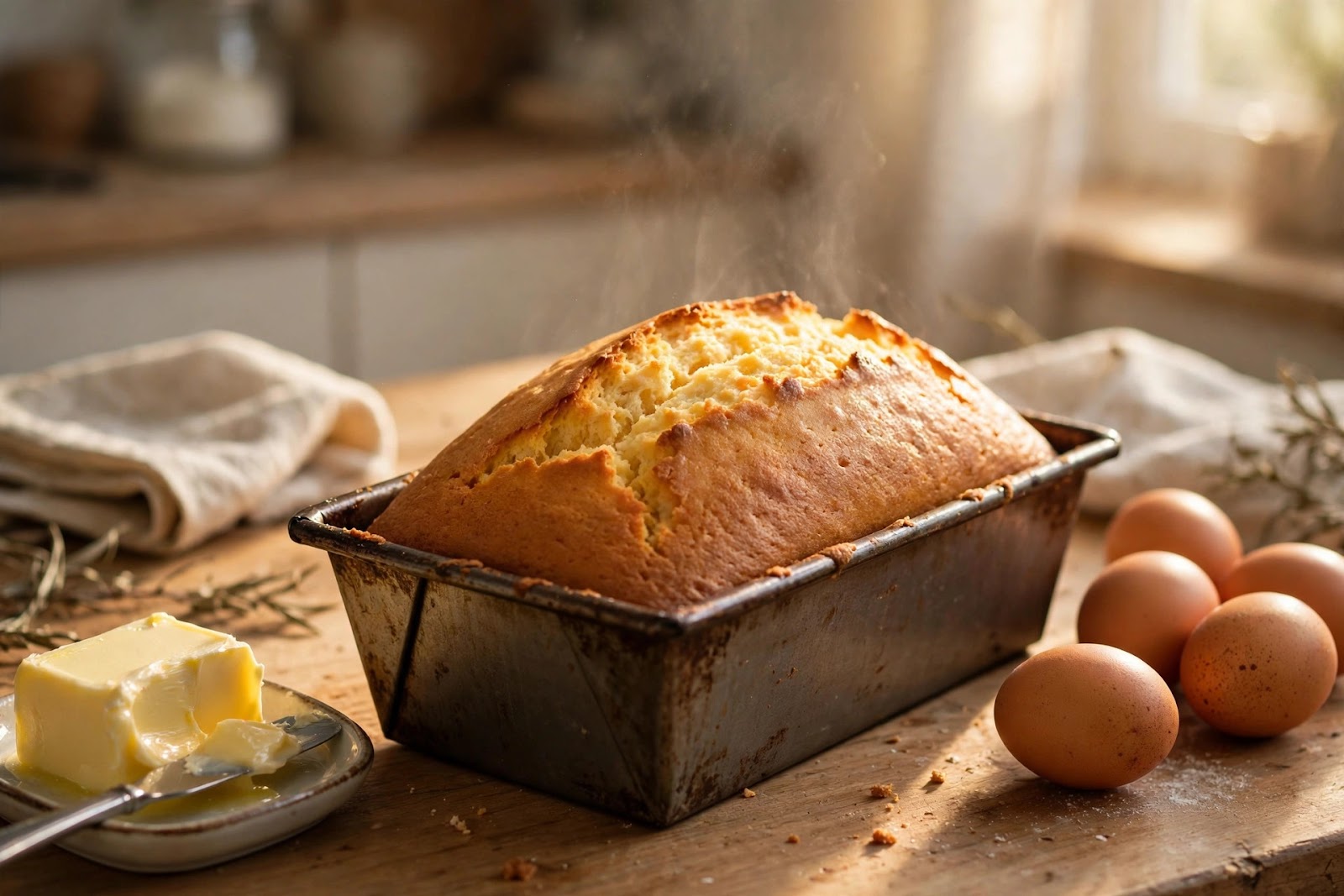
Heat the oven to 160 degrees. Line a loaf tin with baking paper. Cream the butter and sugar for five minutes until pale and fluffy. Add the eggs one at a time, beating well after each. Stir in the vanilla and sour cream. Fold in the flour in three goes, just until it disappears. Pour into the tin, smooth the top, and run a knife down the middle of the batter — a shallow line, lengthways. That line helps the cake split neatly as it rises instead of cracking wherever it likes. Bake for 60 to 70 minutes until a skewer comes out with moist crumbs. Cool ten minutes in the tin, then on a rack until completely cool.
That is it. No syrup, no soaking, no glaze needed. The cake keeps for four days wrapped in cling film at room temperature, and it actually gets better on day two, when the crumb has settled. If you want to freeze it, slice it first, wrap the slices individually, and they defrost in about 20 minutes on the counter. I keep a few slices in the freezer for the days when only cake will do.
What dry really means
The thing I finally understood is that dry pound cake is almost never about water. It is about air, temperature, and time. Air beaten in during creaming. Butter at the right softness. Eggs at the right temperature. Flour mixed as little as possible. An oven that is actually at the temperature it claims. A cake taken out before it looks done and left alone until it is cool.
Each of those sounds small. Together they are the whole cake. My brother-in-law had a second slice of the last one, without reaching for the tea. That is the review I bake for now.


