The first pumpkin pie I ever baked looked like a map of the San Andreas fault. I pulled it out of the oven feeling proud — golden crust, kitchen smelling like November — and by the time it cooled, the top had split into three deep cracks. It still tasted fine. Nobody at the table said a word about it. But I knew. And every pie after that did the same thing, like the cracks were part of the recipe.
It took me four autumns to figure out what was going on, and the fix turned out to be three small things. Not a new recipe. Not a different pan. Just the bake time, the cooling, and the way I whisked the filling. Once I changed those, the cracks stopped for good.
The crack is not a crust problem
For two years I blamed the crust. I tried a thicker rim. I tried egg wash, foil shields, a different pie dish. None of it mattered, because the crack was never in the crust. It was in the filling.
Pumpkin pie filling is basically a custard. Eggs, pumpkin purée, cream, sugar, spices. And custards have one unforgiving rule: if they get too hot, the eggs overcook, tighten up, and pull apart as they cool. The surface splits because the inside contracted. That's it. No mystery, no curse.
The problem is that the standard advice — bake until the center is set — almost guarantees you'll overshoot. A pumpkin pie that looks fully set in the oven is already overbaked. The center should still wobble when you take it out. I know how wrong that sounds. The first time someone told me that, I thought they were joking.
The wobble test I finally trusted
Here's what I do now. I bake at 190°C for the first 15 minutes, then drop to 175°C for the rest. Total time is usually 45 to 50 minutes for a standard 9-inch pie. At 40 minutes, I start checking.
I give the rack a gentle nudge with an oven mitt. The outer two-thirds of the filling should be set — it moves as one piece, like a firm jelly. The center, about the size of a coin, should jiggle. Not slosh. Jiggle. If the whole surface ripples like a wave, it needs another five minutes. If nothing moves at all, you've gone too far, and you should pull it out right now and hope for the best.
The first time I trusted the wobble, I stood in front of the oven for a full minute, convinced I was about to serve raw pie to my family. I wasn't. The filling finishes setting from residual heat as it cools. It needs that carryover time. A pie pulled at the wobble stage finishes perfectly smooth. A pie pulled when it looks done finishes cracked.
An oven thermometer matters here more than anywhere else in baking. My oven runs about 12 degrees hot, which I only discovered the year I finally bought one. Twelve degrees is the difference between a smooth top and a fault line. If your pies always crack and your cakes always dome, spend the few dollars. It's the cheapest fix in baking.
Cooling slowly is half the recipe
The second fix was cooling. I used to do what felt natural: take the hot pie out of the oven and set it on the counter, sometimes near an open window because the kitchen was warm. Then I'd watch the crack appear as the surface cooled too fast.
Custard shrinks as it cools. If the surface cools much faster than the center, the top contracts while the inside is still warm and puffed. Something has to give, and it's always the surface. Slow cooling lets the whole pie settle at the same pace.

Now I turn the oven off, crack the door open about an inch, and leave the pie inside for 15 minutes. Then I move it to a wire rack on the counter, away from drafts, and leave it alone for at least two hours. No fridge. Not yet. The fridge is the third mistake — cold air on a warm custard is the fastest way to crack it.
I know two hours feels like forever when the house smells like pumpkin and spice. That's what whipped cream is for. Make it while you wait. The pie will still be there.
The whisking mistake I didn't know I was making
The third fix surprised me most, because it happens before the pie even goes in the oven. I used to whisk the filling like I was beating eggs for an omelette — fast, hard, lots of air. The filling went into the pan full of tiny bubbles, and I thought that was fine. It wasn't.
Air bubbles in a custard expand in the heat and then collapse as the pie cools. Every one of them is a weak spot in the surface. A filling full of bubbles is a filling full of future cracks. It also puffs up in the oven and then sinks, which makes the cracking worse.
Now I whisk gently, in slow circles, just until everything is combined. I mix the pumpkin, sugar, and spices first, then the eggs one at a time, then the cream last, stirring instead of whipping. If I see bubbles on the surface, I tap the bowl on the counter a few times and pop them with a spoon. It takes thirty extra seconds. It saves the whole pie.
One more thing: don't overbake the crust edges while you're protecting the filling. I cover the rim with a strip of foil or a pie shield after the first 20 minutes. Burned edges and a cracked top used to arrive together in my kitchen, and the shield fixed the first half of that problem while the wobble test fixed the second.
My filling, the way I make it now
I use one can (425g) of plain pumpkin purée — not pie filling, which already has sugar and spices in it and makes the whole thing unpredictable. Three large eggs, at room temperature. Cold eggs make the filling lumpy and slow the set. I take them out of the fridge when I start the crust.
For the dairy, I use 300ml of double cream. Evaporated milk works and it's the classic choice, but cream gives me a silkier set and a little more forgiveness on bake time. If you use evaporated milk, pull the pie five minutes earlier than you think.
Sugar is 150g of light brown sugar, and the spices are 2 teaspoons of cinnamon, half a teaspoon of ginger, a quarter teaspoon of nutmeg, and a pinch of cloves. I mix the spices into the sugar first so they don't clump in the wet filling. Clumps of dry cinnamon in a smooth custard are a small thing, but once you've seen them you can't unsee them.
The crust is my standard shortcrust, blind-baked for 15 minutes with baking beans and five minutes without, until it's pale gold. A soggy base under a perfect filling is its own heartbreak, and blind baking is the only thing that ever fixed it for me. But that's a story for another day.
When it still cracks (and how to save it)
Sometimes you do everything right and the pie still cracks. Maybe the oven ran hot that day. Maybe the eggs were bigger than usual and the filling set differently. It happens, and it's not a disaster — it's a pie with a line on it, and there are good ways to deal with that.
The easiest rescue is whipped cream. Not a polite dollop — a proper layer, spread right to the edges, thick enough to hide the crack completely. Nobody has ever complained about too much whipped cream on pumpkin pie. I sweeten mine with a tablespoon of icing sugar and a splash of vanilla, and I whip it to soft peaks so it sits in lazy waves instead of stiff points.
If you want something fancier, a thin layer of chocolate ganache works beautifully. Pour it over the cooled pie, tilt the dish until it covers the surface, and let it set in the fridge for twenty minutes. The dark chocolate against the orange filling looks intentional, like you planned it, and it tastes wonderful with the spices.
Crystallised ginger, chopped fine and scattered over the top, is another good cover. So are toasted pecans. The rule is simple: whatever you put on top should look like a garnish, not a bandage. Spread it evenly, edge to edge, and nobody will ever know.
And honestly? A cracked pie still tastes like pumpkin pie. I have served cracked pies to people who asked for the recipe. The crack is a cosmetic problem, not a flavour problem. Fix what you can, cover what you can't, and serve it warm with cream. That's what the pie is for.
Storing it without ruining it
Once the pie has cooled completely — and I mean completely, at least four hours on the counter — you can cover it loosely with cling film and put it in the fridge. It keeps well for three days. The crust softens a little by day two, but the filling stays good.
Don't cover a warm pie. The steam gets trapped under the film, condenses, and drips back onto the surface. You'll get a wet top and, sometimes, a fresh crack as the cold drips hit the warm custard. Let it cool first, then cover it.
I don't freeze whole pumpkin pies. The filling goes a little grainy when it thaws, and the crust turns soggy in a way that reheating can't fix. If you need to bake ahead, make the crust and freeze that instead, then fill and bake the day you need it. The whole bake takes under an hour of active work, and a fresh pie is always worth it.
Leftovers reheat fine, by the way. Ten minutes in a 160°C oven, or a slice microwaved for twenty seconds with a spoonful of cream on top. Cold from the fridge, straight out of the dish with a fork, is also perfectly acceptable. I've done all three. I recommend all three.
The pie that finally stayed smooth
The autumn I put all three fixes together, I was baking for a small family dinner — six people, nothing fancy. I pulled the pie at the wobble stage, left it in the cooling oven, whisked the filling gently for once, and then tried very hard not to stare at it while it cooled.
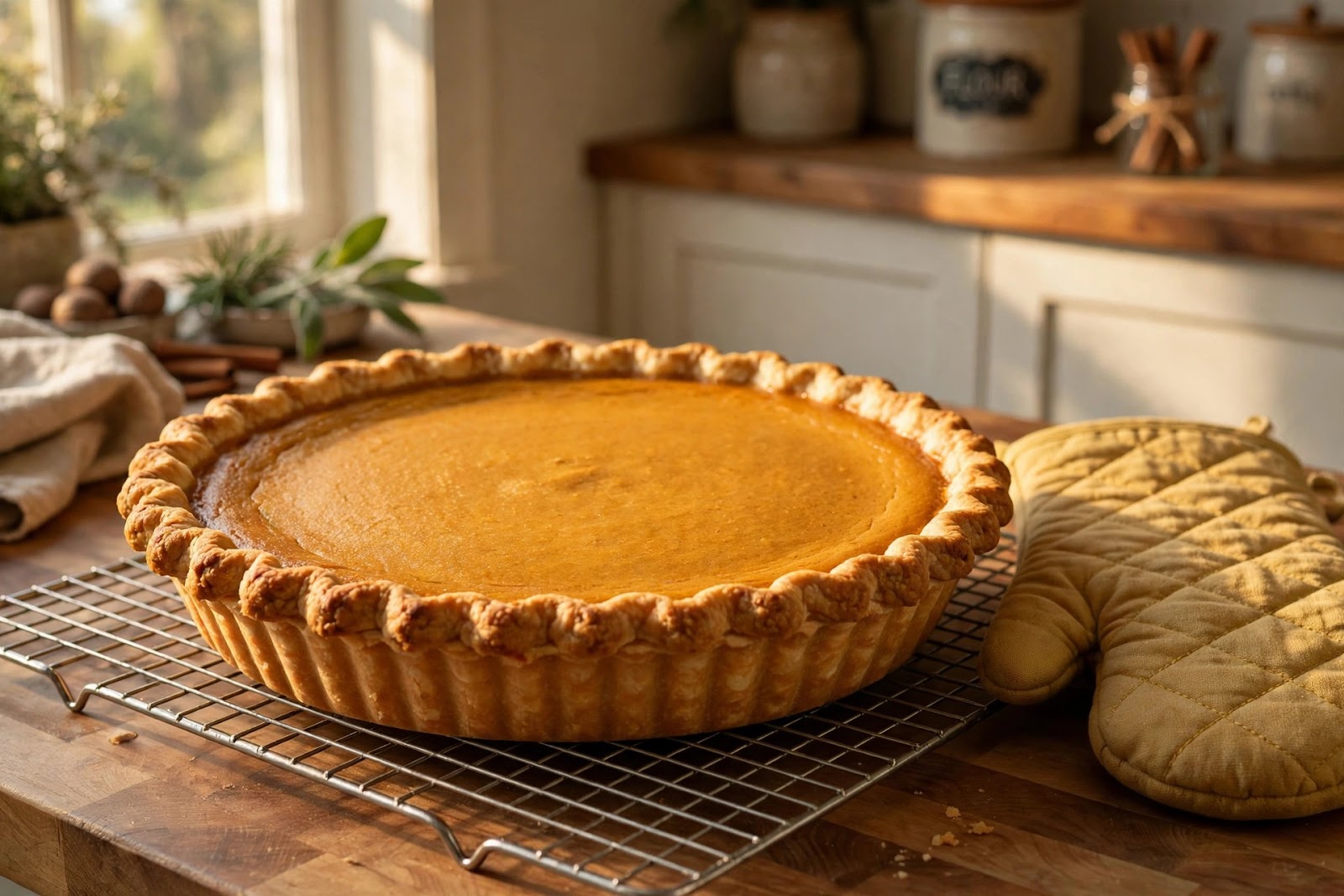
Two hours later I lifted the foil and the surface was completely smooth. Not one crack. I actually laughed out loud in my kitchen, alone, at a pie. My mother-in-law cut the first slice and it held its shape on the plate, the filling dense and silky instead of spongy. That was three years ago. I haven't had a cracked pumpkin pie since.
If your pies keep cracking, don't buy a new dish and don't switch recipes. Bake it five minutes less than you think, cool it slower than feels natural, and stir the filling like you're trying not to wake it up. The pie will do the rest.


