My Yule Log Cracked When I Rolled It — Chocolate Sponge, Warm Ganache, and the Tea Towel Roll That Worked
The first yule log I ever made looked like a crime scene. I had rolled it while it was still hot, the way the recipe told me to, and the sponge split clean down the middle like a fault line. Chocolate sponge everywhere, cream oozing out of the crack, ganache sliding off the top in sad brown sheets. I stared at it for a full minute, spatula in my hand, and then I did what any sensible person does in that situation: I pushed the two halves together, smeared ganache over the join like plaster, and told everyone it was meant to look rustic.
Nobody believed me. My brother asked if the log had been in a fight. My aunt, who has been baking Christmas cakes since before I was born, took one look and said, "Ah, you rolled it too tight, love," in the tone of someone who has seen this exact disaster before and is too kind to laugh out loud.
She was right, of course. But she was also only half right, because the rolling wasn't the only problem. The sponge was too dry, the tea towel was the wrong kind, and I had filled it with cream that was too stiff to bend. A yule log is a chain of small decisions, and I had got most of them wrong. It still tasted wonderful — chocolate sponge and cream always do — but it looked like something the dog had got at.
Three Decembers later, I have made this log seven times, and the last four have been the kind of cake people photograph before they cut it. The difference isn't talent. It is a short list of specific fixes, and every single one of them came from a mistake I made in my own kitchen. This is the version I make now, the one that rolls without cracking, and I am going to tell you exactly where the first one went wrong so yours doesn't.
The sponge is the whole game
A yule log sponge is not a normal cake. A normal cake wants to be tall and proud. A sponge for rolling wants to be thin, flexible, and a little bit damp, like a good towel. The recipe I use now is deliberately simple: 4 large eggs, 100 grams of caster sugar, 65 grams of plain flour, 35 grams of cocoa powder, 1 teaspoon of baking powder, a pinch of salt, and 1 teaspoon of vanilla extract. No butter in the sponge at all. Butter makes a sponge rich and tender, but it also makes it stiff when it cools, and stiff is the enemy of rolling.
Separate the eggs. This is the step everyone wants to skip and nobody should. Whip the yolks with half the sugar until they go pale and thick — about three minutes with a whisk, or two minutes with a hand mixer if yours hasn't died in a cloud of smoke like mine once did. In a separate clean bowl, whip the whites with the rest of the sugar until they hold soft peaks. Soft peaks, not stiff. Stiff whites make a sponge that puffs up beautifully and then cracks the moment you ask it to bend. Soft peaks fold in gently and give you a sponge that stays flexible.
Sift the flour, cocoa, baking powder, and salt together, then fold them into the yolk mixture in two goes, alternating with spoonfuls of the whipped whites. Fold means fold: cut down through the middle with a spatula, scoop up from the bottom, turn the bowl a quarter turn, repeat. It takes about twenty folds. If you stir it like soup, you knock out all the air you just whipped in, and the sponge comes out flat and rubbery. My second log was flat and rubbery. I stirred it like soup. I know.
Spread the batter into a Swiss roll tin — mine is 33 by 23 centimetres — lined with baking parchment. Get it right into the corners and level it with a palette knife. The layer should be about a centimetre thick, even all over. If it is thicker at one end, that end will bake faster and crack first. Bake at 200 degrees Celsius for 10 to 12 minutes. Not a minute longer. A rolled sponge overbakes in the time it takes to answer a text message, and an overbaked sponge is a dry sponge, and a dry sponge cracks. At ten minutes, touch the top gently. It should spring back and leave no dent. If it springs back, it is done. Take it out.
The tea towel, and why the wrong one ruins everything
Here is where my first log truly died. The recipe said "roll in a tea towel dusted with sugar" and I grabbed the nearest tea towel, which was a thick waffle-weave one my grandmother had given me, and dusted it with caster sugar. Three problems. The waffle texture pressed into the sponge and left it patterned like a golf ball. The caster sugar was too coarse and scratched the surface. And I rolled it while it was still steaming hot, tight as a sausage, which put a permanent crease down the middle that split open the moment I unrolled it.
The towel you want is a thin, flat cotton one — the kind that looks boring and feels smooth. No waffle, no texture, no terry cloth. If you don't own one, a clean pillowcase works, or a large piece of baking parchment. Dust it with icing sugar, not caster sugar, because icing sugar is fine enough to sit on the surface without scratching it, and it dissolves into the sponge instead of crunching.
The rolling itself is the part that feels like a magic trick the first time you get it right. Turn the hot sponge out onto the sugared towel. Peel off the baking parchment — it should come away cleanly if you lined the tin properly — and then, starting from one short end, roll the sponge up inside the towel. Not tight. This is the mistake I made and the mistake almost everyone makes. Roll it loosely, like you are rolling a sleeping bag, not wringing out a cloth. The roll should feel soft and a little bit loose in your hands. If you squeeze it tight, you are putting a crease in it that will split later.
Leave it rolled up in the towel until it is completely cool. At least an hour. This is the hardest part, because you want to peek. Don't peek. The sponge is learning its shape while it cools, and every time you unroll it early you are teaching it to crack. Go and do something else. Wrap presents. Make the ganache. The log will wait.
The filling that bends instead of breaking
While the sponge cools, make the filling. I use 300 millilitres of double cream, 2 tablespoons of icing sugar, and 1 teaspoon of vanilla extract. Whip the cream until it just holds soft peaks — the same rule as the egg whites. Cream that is whipped stiff is cream that will squeeze out of the sides when you roll the log, and it will also crack the sponge because it has nowhere to go. Soft cream spreads, bends, and stays where you put it.
Unroll the cooled sponge gently. It will hold a curl, which is exactly what you want. Spread the cream over it, leaving a two-centimetre border bare at the far end — the end you finish rolling towards — because the cream gets pushed forward as you roll and it will spill out the end if you spread it all the way. That border is the difference between a neat log and a log sitting in a puddle of cream on your worktop. I have served the puddle version. Nobody complained, but I knew.
Roll it up again, this time without the towel, using the towel underneath to help you lift and guide the sponge over. Go slowly. If you see a small crack starting, stop, breathe, and keep going gently — a small crack under ganache is invisible, and ganache is the most forgiving thing in baking. My third log had three small cracks on the top. The ganache covered all of them. Nobody at the table ever knew.
Ganache that rescues everything
The ganache is the reason a yule log is so forgiving, and it is also the reason mine looked like a disaster the first time. I made the ganache too hot and poured it straight onto the log, where it ran off the sides and pooled on the board. The log looked like it had been left out in the rain. Warm ganache is a liquid. You need ganache that has cooled to the point where it holds a soft peak on the spatula — spreadable, not pourable.
Here is the ratio: 200 grams of dark chocolate, chopped small, and 200 millilitres of double cream. Heat the cream in a saucepan until it just starts to steam and you can see tiny bubbles around the edge. Don't boil it. Pour it over the chocolate in a bowl, leave it alone for two minutes, then stir from the middle outward until it turns glossy and smooth. Leave it on the counter for 30 to 40 minutes, stirring it once or twice, until it thickens to the consistency of soft buttercream. If your kitchen is warm, it might take an hour. If it is cold, 25 minutes. The ganache will tell you when it is ready — drag a spoon through it and the trail should hold for a second before slowly closing up.
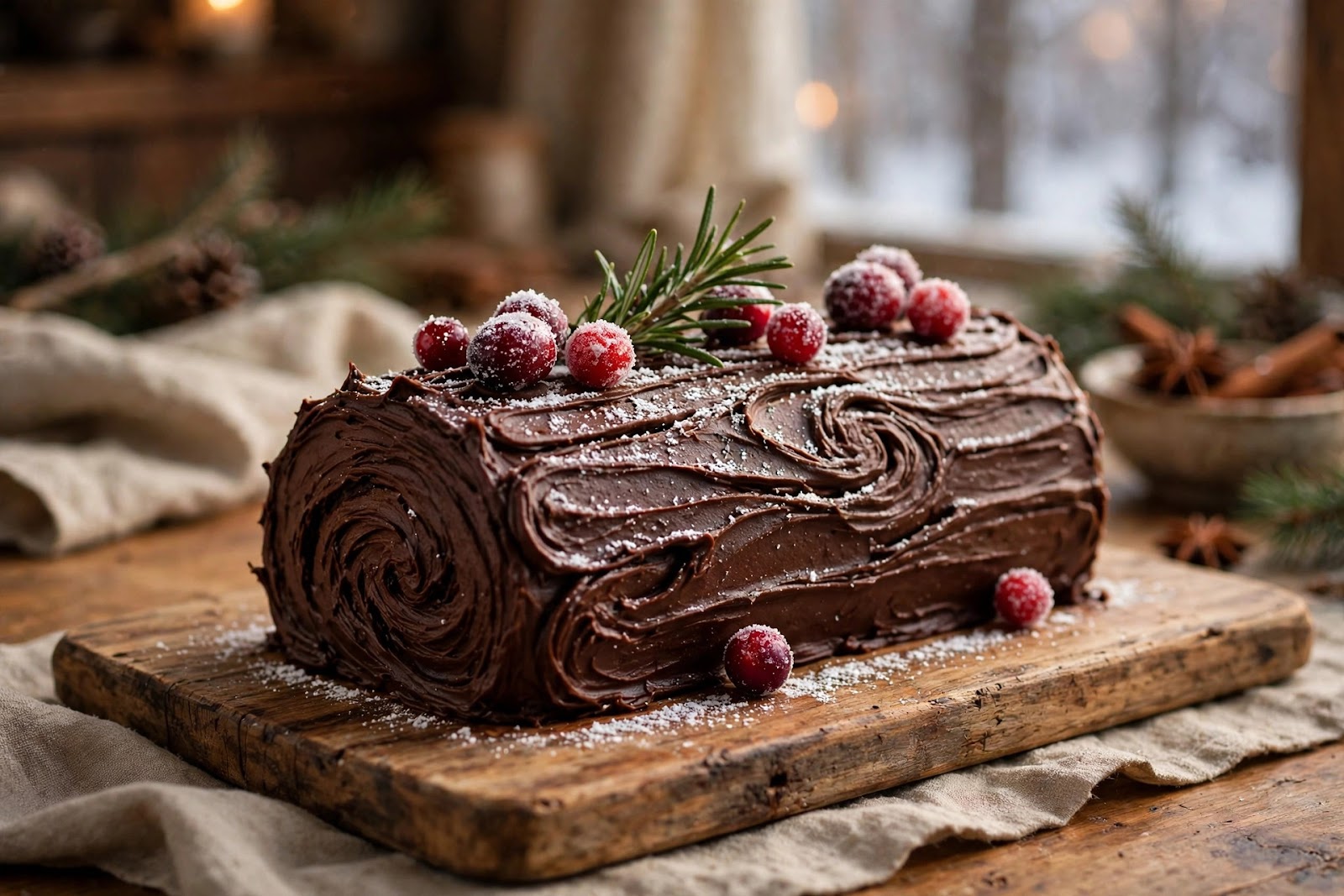
Spread it over the log with a palette knife, all over the top and sides. Then drag a fork through it lengthways, in long lines, to make the bark texture. Don't press hard — light, even strokes. Wipe the fork clean every few strokes so the lines stay sharp. The fork lines are the detail that makes people say "oh, it looks like a real log" instead of "oh, it's a chocolate roll." It takes forty seconds and it is worth every one of them.
For decoration, I keep it simple. A light dusting of icing sugar, flicked over the top through a small sieve, looks like snow. A few sugared cranberries — fresh cranberries rolled in caster sugar while still damp — and one small sprig of rosemary, which looks like a pine branch and smells wonderful when someone leans in to cut a slice. That is it. No plastic robins, no meringue mushrooms, no gold leaf. The first year I went overboard with decorations and the log looked like a Christmas market had exploded on it. Simple wins.
The timing that saves Christmas Eve

A yule log is a make-ahead cake, and that is its secret weapon at Christmas. The sponge can be baked and rolled in the towel the day before, wrapped in cling film once it is cool, and kept in the fridge overnight. Fill it and ganache it the next morning, and it will be ready by lunch. The finished log keeps in the fridge for two days, and honestly it tastes better on day two, once the cream has had time to soften the sponge and the flavours have settled together.
If you are making it on the day, start four hours before you want to serve it. One hour for the sponge to cool in the towel, thirty minutes for the ganache to thicken, an hour in the fridge for the whole log to set, and the rest is breathing room. I have made this log on Christmas morning twice, starting at eight, and served it at one o'clock with no panic at all. The first year, when I started at eleven, I was still dusting icing sugar on it while everyone was sitting down. Don't be me in year one.
One more timing note: take the log out of the fridge thirty minutes before you serve it. Cold ganache is hard and the sponge is firm, and the slices come out ragged. At room temperature, the ganache softens, the cream relaxes, and the knife slides through in clean spirals. Cut it with a long sharp knife dipped in hot water and wiped dry between slices. Each slice should show the spiral — dark sponge, pale cream, dark sponge — like a cross-section of a tree. That spiral is the payoff for every careful step.
What went wrong, year by year
Year one: rolled too tight, hot, in a waffle towel with caster sugar. Cracked clean through, ganache poured on too hot, ran off everywhere. Tasted great, looked like a fight.
Year two: I fixed the rolling but overbaked the sponge by three minutes because I was on the phone. Dry sponge, small cracks all along the top edge. Ganache covered them. Lesson: set a timer and stay in the kitchen for a twelve-minute bake. Twelve minutes is not the time to leave the room.
Year three: I whipped the cream too stiff and spread it to the very edge. It squeezed out both ends when I rolled it, and the sponge cracked from the pressure. Lesson: soft peaks, two-centimetre border. I wrote it on the recipe card in capital letters.
Year four: the first good one. I changed nothing from year four to year seven except the decorations, and the log has been reliable ever since. That is the part nobody tells you about baking: once you find the version that works, you stop experimenting and you just make it the same way every year. There is no prize for reinventing a cake that already works.
The cost is reasonable, too. Eggs, cream, chocolate, cocoa — the whole log comes to about £6 in ingredients, and it serves ten people easily. A bakery yule log the same size costs £18 to £25 near me, and most of them are drier than this one. I know, because I bought one the year my oven broke in mid-December and I have never forgotten how disappointing it was. Dry sponge, filling that tasted like it came from a tub, ganache like plastic. Mine is better, and I say that without modesty, because I earned it through three years of cracks.
If you have never rolled a sponge before
If the idea of rolling a hot sponge makes you nervous, here is the truth: the first one will probably crack a little, and it will still be the best chocolate cake on your Christmas table. A crack is not a failure. It is a line you fill with ganache. The people eating it will not inspect it like judges on a baking show. They will eat it, ask for seconds, and ask you to make it again next year.
And next year, you will roll it a little looser, whip the cream a little softer, and take the sponge out thirty seconds earlier, and it will be a little better. That is how baking works. Not in one perfect attempt, but in small corrections, year after year, until the cake you make without thinking is the cake other people remember.
My aunt still tells the story of my first log at Christmas. She tells it fondly now, and she always ends it the same way: "And now she makes the best one in the family." I roll my eyes every time she says it. But I keep making it, every December, in the same tin, with the same thin tea towel, and the same fork dragged through the ganache. Some traditions you choose. This one chose me, the day a cracked log still got eaten to the last crumb.


