The Cranberry Orange Loaf I Bake When the Days Get Short — Tart Berries, a Thick Citrus Glaze, and the Tin Trick That Stopped It Sticking
There's a week every year, usually the last one in November, when the light goes strange. It gets dark at four in the afternoon, the kitchen is cold when I come down in the morning, and I start wanting something sharp and bright from the oven instead of another heavy spiced cake. That's when I make the cranberry orange loaf. Not because it's a tradition — nobody in my family has ever made it — but because it's the bake that tastes like the season actually feels: cold outside, tart and sweet inside, and gone by the next day.
I've made this loaf maybe fifteen times now, and the version I make today is not the version I started with. The first one was too sweet, the second one stuck to the tin so badly I served it in pieces and called it a trifle base, and the third one had all the cranberries sunk in a soggy line along the bottom, like a red fault line running through the crumb. Each failure taught me one thing, and the loaf I bake now has all three fixes built in: less sugar in the batter and more in the glaze, a tin lined properly instead of hopefully, and cranberries tossed in flour so they stay where they're put.
Let me start with the cranberries, because they're the whole point and also the whole problem. Fresh cranberries are sour in a way that surprises people who only know them from sauce at Christmas dinner. Eaten raw, they make your whole face pull in. Baked into a cake, that sourness is exactly what you want — it cuts through the butter and sugar and stops the loaf from tasting like a candle. But they're heavy, and they're wet, and if you just fold them into a loose batter, gravity does what gravity does and they sink.
I use 200 grams of fresh cranberries, and I wash them, dry them properly on a tea towel, and then I toss them in two tablespoons of the measured flour before they go anywhere near the batter. The flour coats each berry and gives it something to grip. I also chop about a third of them in half. Whole berries look beautiful when you slice the loaf, but they also roll. Halved berries stay put, and they bleed a little of their juice into the crumb around them, which gives you these pink streaks that look deliberate and taste even better. The first time I did this, I thought I'd invented something. I hadn't. But it works, and I've done it every time since.
Frozen cranberries work too, and in a way they're more forgiving, because they're firmer and sink more slowly. Use them straight from the freezer, don't thaw them first, and add an extra five minutes to the bake. Dried cranberries are a different thing entirely — they're sweet, not tart, and they turn the loaf into something else, something closer to a tea loaf. It's still nice. It's just not this loaf. If fresh cranberries aren't in the shops yet, wait a week. This is a November bake. It can wait.
The orange is not a garnish, it is the other half of the loaf
The orange matters as much as the cranberry, and I learned that the slow way. My first loaf used the juice of one orange and no zest at all, and it tasted like a plain cake that someone had waved an orange over from across the room. Now I use the zest of two oranges and the juice of one, and the difference is enormous. Zest is where the flavour lives. The oils in the skin carry the smell, and the smell is half of what you taste.
I zest the oranges straight into the sugar and rub the zest in with my fingertips before I add anything else. It takes thirty seconds and it perfumes the whole bowl. You can smell it immediately — that bright, clean orange smell that makes the kitchen feel less grey. Then I juice one of the oranges and keep the juice for the glaze. The second orange I usually eat while the loaf bakes, standing at the counter, because by then I've earned it and because the kitchen smells like oranges and I want to keep it going.
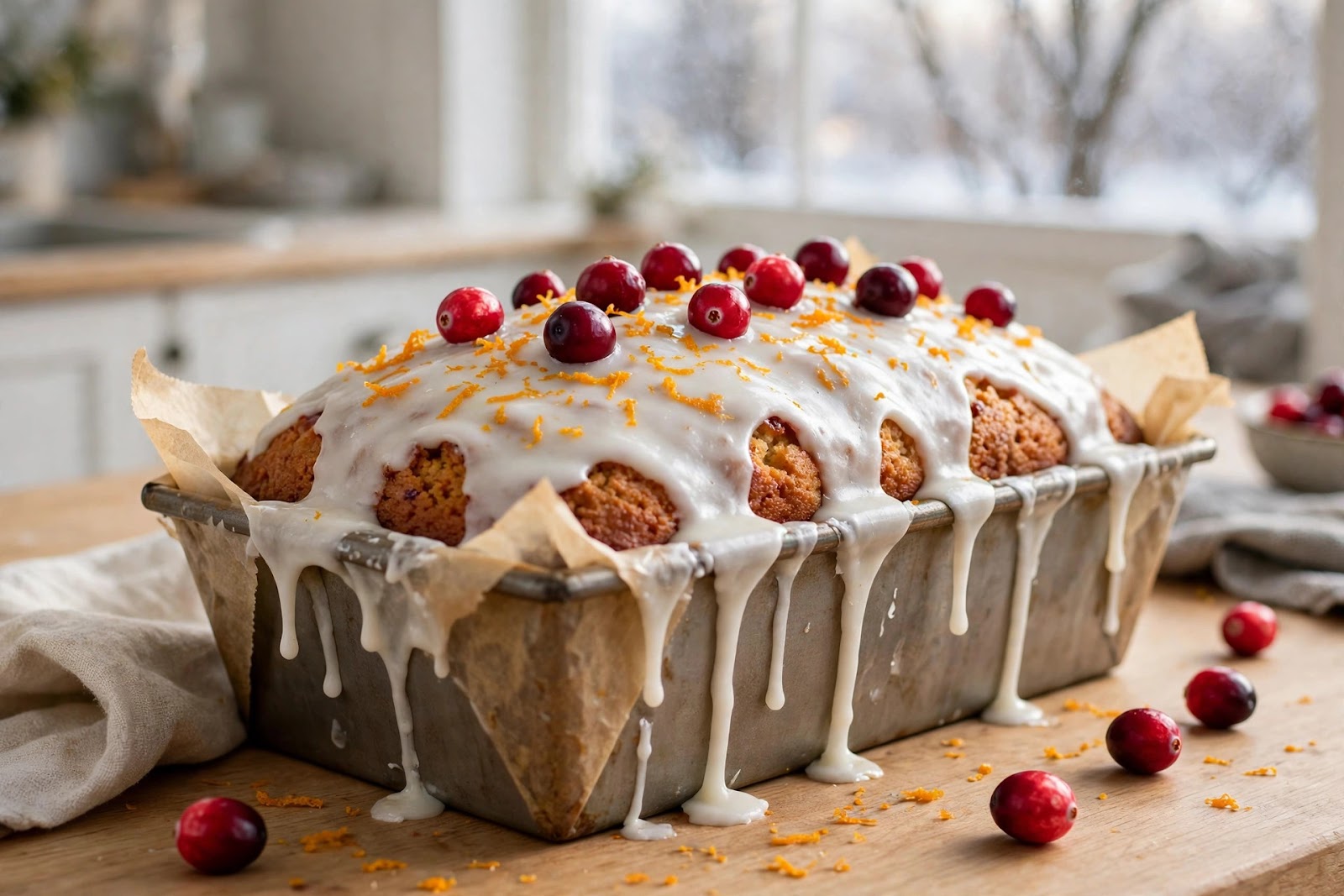
The batter itself is a simple butter loaf, and I don't mess with it much anymore. I use 175 grams of unsalted butter, softened, 175 grams of caster sugar, three large eggs, 225 grams of plain flour, two teaspoons of baking powder, a pinch of salt, and 100 grams of soured cream. The soured cream is the quiet hero here. I tried the loaf with milk, with yoghurt, and with nothing at all, and soured cream wins every time. It keeps the crumb tender for days, and it adds a faint tang that plays nicely with the cranberries. If you can't find soured cream, thick Greek yoghurt is the closest swap. Don't use single cream — it's too thin and the batter goes slack.
I cream the butter and the orange-scented sugar together for a full three minutes, until it's pale and fluffy and the bowl looks like it's full of clouds. This is one of those steps I used to rush, and the loaves showed it — dense, a bit squat, a crumb that was fine but never light. Three minutes feels long when you're standing there watching a mixer turn, but it's the difference between a loaf that rises proud and one that sulks in the tin. Then the eggs go in one at a time, beating well after each one, and if it curdles a little I don't panic — a spoonful of the flour sorts it out.
Then I fold in the flour and baking powder in two goes, alternating with the soured cream, and I mix just until it comes together. Overmixing is the fastest way to ruin a loaf cake, and I know that because I did it, twice, on the same weekend, and produced two loaves with tunnels through the middle like they'd been drilled. The batter should look soft and thick, dropping off the spoon in a slow ribbon. Then the floured cranberries go in, folded through with three or four gentle turns of the spatula, and that's it. No more mixing. The batter goes straight into the tin.
The tin trick that stopped it sticking
Now, the tin. This is the part of the story where I confess that loaf number two stuck so badly I had to chisel it out with a palette knife, and the bottom stayed in the tin while the top came out in my hands, and I ate the top standing over the sink and threw the bottom away, and I was genuinely cross for the rest of the day. I'd greased the tin with butter and dusted it with flour, which is what every recipe says to do, and it still stuck, because this batter is wet and sugary and the cranberries catch on the corners.
What works, every single time now, is a parchment sling. I cut a strip of baking paper long enough to line the base and come up the two long sides of the tin, with a couple of centimetres sticking up over each edge like handles. I butter the tin first so the paper stays put, lay the strip in, and then I butter the paper lightly too. The short ends I leave bare, just well buttered. When the loaf is baked, I let it cool in the tin for ten minutes, then I lift it straight out by the paper handles. It comes out clean, every time, corners and all, and I haven't lost a loaf to the tin since. I use a 900-gram loaf tin, about 21 by 11 centimetres, and I don't fill it more than two-thirds full. This batter rises a lot, and an overfilled tin spills over the sides and burns onto the bottom of the oven, which is a smell that lingers for days. Ask me how I know.
The oven goes to 180 degrees Celsius, 160 fan, middle shelf, and the loaf bakes for 55 to 65 minutes. Mine usually takes an hour. I test it at 55 with a skewer pushed into the centre — it should come out with a few moist crumbs, not wet batter. If the top is browning too fast, foil over the top, loosely, for the last fifteen minutes. The cranberries on the surface go dark and jammy, which is fine and even good, but they shouldn't burn. Burnt cranberry tastes bitter in a way that no amount of glaze will fix.
While the loaf bakes, I make the glaze, and the glaze is not optional. A cranberry orange loaf without the glaze is a perfectly nice cake. With the glaze, it's the cake people ask about. I mix 100 grams of icing sugar with three tablespoons of the reserved orange juice, a teaspoon at a time, until it's thick enough to coat the back of a spoon but still pourable. Too thin and it vanishes into the crumb. Too thick and it sits on top like a white lid. You want it to pour in a slow ribbon and settle into a layer about two millimetres thick, with a few drips running down the sides. I also stir in a pinch of orange zest at the end, which gives the glaze little flecks of colour and a sharper flavour.
Here's the timing that matters: the glaze goes on when the loaf is just warm, not hot and not cold. I let the loaf cool in the tin for ten minutes, lift it out, put it on a wire rack, and wait another ten minutes. Then I pour the glaze over the top and let it run where it wants to. If the loaf is too hot, the glaze melts and slides straight off into a puddle on the rack. I did that once, and the loaf was naked and the rack was glazed, and I had to make a second batch of glaze and start again. If the loaf is cold, the glaze sets before it settles and you get a stiff white cap that cracks when you slice it. Just warm. Touch the side of the loaf — it should feel like a warm mug, not a hot one.

There's a second part to the glaze that I almost left out of this article because it sounds like showing off, but it's the thing people notice. While the glaze is still wet, I scatter a few extra things over the top: a small handful of dried cranberries, a few thin strips of orange zest, and a tablespoon of chopped pistachios. The pistachios are green, the cranberries are red, the zest is orange — the loaf looks like Christmas without trying, and the crunch of the nuts against the soft crumb is genuinely lovely. None of it is essential. All of it is worth doing if you're giving the loaf away or putting it on a table where people will see it before they taste it. For a Tuesday-night loaf just for me, I skip the decoration and eat it warm from the rack with a fork, glaze still slightly tacky. Both versions are correct.
The soggy-bottom line, and how the berries stopped sinking
I said the cranberries sank in my third loaf, and I want to tell you exactly what that looked like, because if it happens to you, you'll want to know it's fixable. I cut the loaf open and there they were: every single cranberry sitting in a damp red line along the bottom, and the top two-thirds of the loaf completely bare. The bottom was wet where the berries had leaked juice as they sank, and the whole slice fell apart when I tried to spread butter on it. It tasted fine, honestly — the flavour was there — but it looked like a mistake, and it ate like one.
Three things fixed it, and I do all three now. First, the flour toss I already told you about — two tablespoons of flour on the berries before they go in. Second, a thicker batter. The soured cream version of this batter is thick enough to hold the berries up while the loaf sets in the oven. The milk version was too thin, and the berries sank before the crumb had a chance to set around them. Third, and this is the one people argue with me about, I put a third of the batter in the tin first, scatter half the berries over it, add the rest of the batter, and scatter the remaining berries on top. Layering the berries instead of mixing them all through means they can't all sink to the same place. They end up distributed through the loaf, some near the top, some in the middle, some near the bottom, and the slices look like the berries were placed there on purpose. Because they were.
The other failure I should mention, because it's the one that will catch you if you're not paying attention, is the oven temperature. My oven runs hot by about ten degrees — I found this out with a cheap oven thermometer that cost me less than a bag of flour and has saved me more bakes than any other tool I own. Before I knew, this loaf kept coming out with a dark, hard crust and a middle that was still wet at an hour. I thought the recipe was wrong. The recipe was fine. The oven was lying. If your loaf is browning fast on top but the skewer still comes out wet in the middle, your oven is probably running hot, and turning it down ten degrees and giving it ten more minutes will fix it. An oven thermometer is the least glamorous baking purchase you'll ever make and the most useful one. I keep mine hanging from the middle shelf all the time now.
This loaf keeps well, which is more than I can say for most cakes I bake. Wrapped in foil or in a tin, it stays moist for four or five days, and the glaze protects the top from drying out. It also freezes beautifully in slices — I wrap individual slices in cling film, put them in a freezer bag, and take one out in the morning for afternoon tea. A slice thawed at room temperature for two hours tastes like it was baked that morning. I don't freeze the whole glazed loaf, because the glaze goes sticky when it thaws.
If you want to change the loaf, change one thing at a time. I've tried it with lemon instead of orange, and it works, but the flavour is sharper and less warm, and I missed the orange. I've tried it with a handful of white chocolate chips folded in with the cranberries, and that's genuinely delicious — the white chocolate melts into sweet pockets that balance the tart berries — but it makes the loaf richer, and I only do it when I'm making it for other people. I've tried it as muffins, same batter in a muffin tin, 22 minutes at the same temperature, glaze drizzled over the top, and those were gone in a morning. The loaf tin is my favourite, though. There's something about slicing a loaf that a muffin can't match.
What I like most about this bake is that it asks almost nothing of you. No yeast, no overnight wait, no special equipment. A bowl, a whisk, a tin, and an hour in the oven. The cranberries do the hard work — they bring the colour, the tartness, the little bursts of juice when you bite into one — and the orange does the rest, lifting the whole thing out of the ordinary. It's the bake I make when someone's coming over and I want the house to smell like I've been baking all day, when I've actually been baking for twenty minutes and the oven's done the rest.
I made it last week for a neighbour who'd just moved in, and I wrapped it in baking paper and tied it with string, and I wrote the date on the paper because that's what I do with bakes I give away. She knocked on my door the next morning and asked for the recipe, and I gave it to her, and she made it the same weekend, and her version stuck to the tin, and she rang me, laughing, to tell me. I told her about the parchment sling. She made it again. It came out clean. That's how baking works, really — one person tells another person the one small thing that fixes it, and the loaf gets better every time it changes hands.
So this is my version, with all three fixes in it: flour on the berries, a parchment sling in the tin, and the glaze on a just-warm loaf. Make it this week, while the cranberries are in the shops and the afternoons are getting dark. Cut it thick, eat it with tea, and save a slice for tomorrow, because it tastes even better the next day, when the orange has settled into the crumb and the glaze has gone slightly crisp at the edges. That's the whole secret of this loaf, if there is one: it's not a special-occasion bake. It's a dark-afternoon bake, and those are the ones you end up making again and again.


