The Freezer Bag of Black Bananas That Finally Became a Walnut Loaf
There was a zip-top bag in my freezer for four months. Six bananas, black as tar, frozen solid sometime in July when I swore I would make banana bread that weekend. I did not. The bag migrated to the back of the freezer, behind the peas and a half-used bag of frozen berries, and every time I saw it I thought the same thing: I should just throw those away.
I am glad I did not. Last Tuesday, on a grey afternoon when the rain would not stop and the house felt too quiet, I finally pulled the bag out. What came out of the oven two hours later was the best banana bread I have made in years. Not the prettiest. The top cracked in a way that looked a bit dramatic. But the crumb was moist all the way through, the walnuts stayed crunchy, and the whole loaf was gone in two days.
This is the story of that loaf, and the handful of small decisions that made it work after so many of my earlier banana breads came out gummy, or dry, or sunk in the middle like a deflated balloon.
The bag I kept meaning to throw away
I freeze bananas the way a lot of home bakers do. A banana goes spotty on the counter, then black, then nobody wants to eat it, so into a bag it goes. Peel first, always. I learned that the hard way the first time I froze them in their skins and then tried to peel a rock-hard banana with a knife while it slid around the counter. Never again.
The bag in question had six bananas in it. Or five. I honestly could not remember, which tells you how long it had been there. When I finally counted, it was six, and they had frozen into one solid lump. I had written nothing on the bag, no date, no count, just a bag of black lumps that looked like something you would find in a compost bin.
Here is the first thing I got right this time: I let them thaw completely. Not halfway, not mostly. Completely. I put the bag in a bowl on the counter for about three hours and then emptied the whole thing, liquid and all, into a measuring jug. That liquid is the whole point. People throw it away. Do not throw it away.
The thawed bananas gave me just over one and a half cups of pulp and juice, which is more banana than most recipes call for. A standard loaf wants about one and a quarter cups, roughly three medium bananas. I had more, and I used all of it. That decision shaped everything that followed, because extra banana means extra moisture, and extra moisture is exactly what tips a loaf from moist into gummy if you are not careful.
Thawing them was messier than I expected
Thawed frozen bananas are not pretty. They come out of the bag as a dark, syrupy mush with a smell that is much stronger than a fresh banana. Sweet, almost boozy. The first time I did this, years ago, I stood over the bowl and thought I had done something wrong. I had not. That intense smell is just a very ripe banana doing what very ripe bananas do.
I mashed them with a fork right in the jug. No blender, no mixer. A fork leaves a few small lumps, and I like that. A completely smooth puree makes a loaf that eats like cake, and I wanted bread. Something with a bit of texture. The lumps mostly disappear in the bake anyway, but they leave tiny pockets of banana that stay soft.
One practical note, because I have ruined a countertop over this: thaw frozen bananas in a bowl, not on a plate. The bag leaks. It always leaks a little at the seal, and banana juice dries into a sticky brown film that takes real scrubbing. A deep bowl catches all of it, and the juice goes straight into the batter where it belongs.
While the bananas thawed, I got everything else ready. I turned the oven on to 350 degrees Fahrenheit, which is 175 Celsius, and I put the rack in the lower third of the oven. My oven runs about 10 degrees hot on the top rack, so the lower third keeps the top of the loaf from browning before the middle is done. I greased a 9 by 5 inch loaf pan with soft butter and lined the bottom with a strip of parchment, leaving the ends hanging over the sides like handles. That strip has saved me more times than I can count. You lift the loaf out clean instead of wrestling it.
The walnut question
Every banana bread argument I have ever had with another baker comes down to walnuts. Some people think they ruin the loaf. Some people, me included, think a banana loaf without walnuts is missing its best part. My grandmother put walnuts in hers, chopped rough, never fine, and the crunch against the soft crumb is the whole memory for me.

But here is the honest part: walnuts can also wreck a loaf. I have made versions where the nuts sank to the bottom in a sad, dense layer, and versions where I used so many that every bite was more nut than bread. The fix is embarrassingly simple, and it took me years to bother doing it. Toast them first, chop them rough, and toss them in a spoonful of the flour before they go into the batter.
Toasting takes eight minutes in a dry pan over medium heat, shaking the pan every minute or so. You will smell them turn from raw and slightly bitter to warm and nutty, and that smell is your cue. The second they smell done, tip them out onto a plate. They keep cooking in a hot pan, and burnt walnuts taste like an ashtray. I have burned exactly one batch, and I could smell it from the next room.
I used one cup of walnut halves, which came to about 115 grams, toasted and chopped into pieces roughly the size of a pea. Half went into the batter, and half went on top of the loaf before it went into the oven. The ones on top get darker and crunchier in the bake, and they make the loaf look like something from a bakery instead of something that came out of a freezer bag.
If you hate walnuts, pecans work the same way. Chocolate chips work too, though they make a different loaf, sweeter and more like dessert. I have nothing against that version. It just is not the loaf I was chasing on a rainy Tuesday.
Brown butter, and why I stopped skipping it
Most banana bread recipes call for melted butter or oil. I used to reach for oil because it was faster, and honestly the results were fine. Fine, though, is not the same as good. The day I started browning the butter was the day my banana bread stopped tasting like every other banana bread.
Brown butter takes five minutes. You put half a cup of butter, one stick, 115 grams, in a small saucepan over medium heat. It melts, then it foams, then the foam starts to clear and the little milk solids at the bottom turn golden brown. The smell changes completely. It goes from plain butter to something nutty and almost like toffee. The second you see brown specks, pull the pan off the heat and pour the butter into a bowl, specks and all. It keeps browning in the hot pan, and burnt butter is bitter in a way no amount of sugar fixes.
I let it cool for ten minutes while I measured everything else. Hot butter plus eggs equals scrambled eggs in your batter, and I have made that mistake exactly once. It was not a disaster, but the loaf had little yellow flecks that no one could identify, and I spent the whole afternoon pretending they were supposed to be there.
The rest of the batter is simple. Two large eggs, at room temperature, beaten into the cooled brown butter with three quarters of a cup of sugar. I used a mix this time: half a cup of white sugar and a quarter cup of brown sugar, because the brown sugar adds a little molasses note that plays well with the walnuts. A teaspoon of vanilla, a pinch of salt, and then the banana mush, juice and all.
Here is a small thing that matters more than it should: I whisk the eggs and sugar together for a full minute, by hand, until the mixture looks a little pale and thick. It is not a real creaming step, but it puts air into the batter, and air is what keeps a heavy banana loaf from turning into a brick.
Moist versus gummy, and where the line actually is
This is the part I got wrong for years. I thought more banana meant more moisture, and more moisture was always better. It is not. There is a line between a moist crumb and a gummy one, and the line is thinner than most recipes admit. A gummy loaf looks fine on the outside, slices fine, and then sits in your mouth like wet sponge. I have served that loaf to guests. I have watched people chew it politely.
The fix is not less banana. The fix is giving the extra moisture somewhere to go, and that means flour and time. I used two cups of all-purpose flour, 250 grams, weighed, not scooped. I weighed my flour for this loaf because I finally learned that a scooped cup can weigh anywhere from 120 to 150 grams depending on how packed it is, and a 30-gram difference is the difference between moist and gummy. My kitchen scale cost me about twelve dollars years ago and it is the best baking purchase I have ever made.
One teaspoon of baking soda, half a teaspoon of baking powder, and half a teaspoon of fine salt, whisked into the flour before it meets the wet ingredients. The baking soda does the heavy lifting with all that acidic banana. The powder is there for a little extra lift, and I know some bakers will tell you that you only need one of them. I have tried it both ways. The combination gives me a better rise on a heavy batter, so I keep it.
Then the only rule that really matters: fold the flour in until you cannot see dry streaks anymore, and stop. Do not keep stirring. Do not go back for one more turn. The moment the last white streak disappears, the spoon comes out. Overmixed banana bread is tough and dense, and no amount of baking fixes it. I fold with a spatula, scraping the bottom of the bowl, and I count to about fifteen folds. That is usually enough.
The walnuts went in with the last few folds, half a cup into the batter and the rest saved for the top. The batter was thick, thicker than cake batter, and it dropped off the spatula in slow ribbons. That thickness is a good sign. A thin, runny banana batter almost always sinks in the middle.
The bake itself
Into the pan it went, smoothed out with the spatula, and the remaining walnuts scattered over the top. I also sprinkled a tablespoon of coarse sugar over the top, which is a trick I picked up from a bakery loaf years ago. It melts into a thin, crackly crust that gives the first slice a little crunch. It is not necessary. It is very good.
The loaf went into the oven for 60 minutes, and I did not open the door for the first 45. Opening the door early is how a loaf sinks. The rush of cool air drops the temperature right when the crumb is setting, and the middle collapses. I have done it. I have stood there at minute 30, impatient, and paid for it with a canyon down the center.
At 45 minutes the top was deep golden and the walnuts on top were dark. I tented a piece of foil loosely over the pan, just laid across the top, not tucked in, and let it finish. The foil stops the top from burning while the middle catches up. At 60 minutes I tested it with a wooden skewer pushed into the center. It came out with a few moist crumbs stuck to it, not wet batter. That is done. A completely clean skewer means the loaf is already a little overbaked, in my experience, and a wet skewer means five more minutes.
It took 63 minutes in my oven, total. Your oven will differ. Start checking at 55 minutes and trust the skewer more than the clock.
Then the hardest part of the whole recipe: I left it alone. Ten minutes in the pan on a wire rack, then I lifted it out by the parchment handles and let it cool for a full hour before slicing. Cutting a hot banana loaf is a mess. The crumb is still setting, the slices tear, and the steam escapes and dries the loaf out. I have cut into a warm loaf more times than I should admit, and every time I have regretted it within two bites.
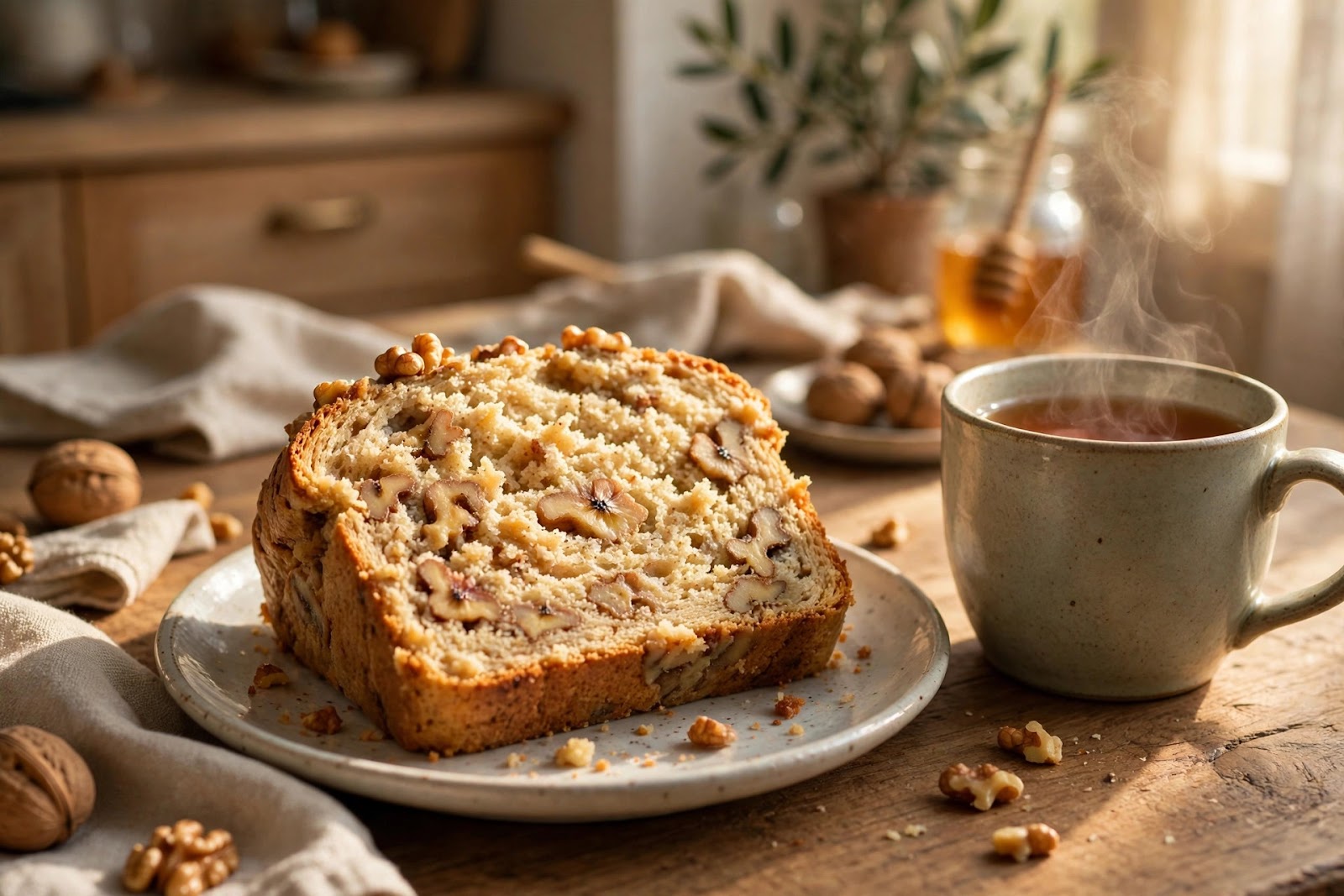
When I finally sliced it, the crumb was even, golden, and damp without being wet. The walnuts were distributed all the way through instead of sunk at the bottom. The top had a crack running down the middle, which is exactly what a good quick bread should look like. I ate the end piece standing at the counter, still a little warm, and it was the best thing I had baked in months.
What I would change next time
Almost nothing, which is rare for me. I would write the date on the freezer bag, because I spent ten minutes trying to remember how old those bananas were, and nobody needs that mystery. I would also measure the banana pulp before I start, because this time I lucked into one and a half cups and it worked, but if the next bag gives me two cups, the loaf will need a little more flour or a little more time.
One thing I would keep exactly the same: the brown butter. It is five minutes of work and it is the difference between a loaf that tastes like banana and a loaf that tastes like something. The nutty, almost caramel note sits underneath the banana instead of on top of it, and it makes the whole loaf taste more deliberate.
I would also keep the coarse sugar on top. It cost nothing, it took three seconds, and it made the loaf look and taste like it came from a bakery. Small touches like that are the reason I keep baking the same recipes over and over instead of chasing new ones. A recipe is not finished the first time it works. It is finished the fifth time, when you know which corners you can cut and which ones you cannot.
Storing it, and the two-day test
The loaf kept well, which matters, because a banana loaf that dries out by day two is a failed loaf in my book. I wrapped the leftover half tightly in plastic wrap, then in foil, and left it on the counter. Day two it was still soft, and the walnuts were still crunchy, which surprised me. Usually nuts go soft overnight. The toasted ones held up better than raw ones ever did, and that is another small argument for toasting.
By day three the end was getting a little dry, so I sliced the rest and toasted it in a dry pan with a little butter, which is my favorite way to rescue the last of any quick bread. Two minutes a side, until the edges crisp, and it tastes almost better than fresh. If you have more than you can eat in three days, slice it, wrap the slices individually, and freeze them. They thaw in twenty minutes on the counter, or straight into the toaster from frozen.
The freezer bag is empty now. The bag itself went into the recycling, and the freezer has one less mystery lump in it. I already have two bananas going spotty on the counter, and this time I am not waiting four months. The next bag gets a date on it, a count on it, and a plan. Banana bread is not a rescue mission. It is just what you do with bananas that got too ripe to eat, and the freezer is the pause button, not the graveyard.
If you have a bag like mine sitting in your freezer, pull it out this weekend. Thaw it in a bowl, save the juice, brown the butter, toast the walnuts, and do not open the oven door before 45 minutes. The loaf will not be perfect. Mine was not. But it will be yours, and it will be better than the bag of black bananas you have been avoiding since July.


